Mamiya’s ordeal in the dry well
The Wind-Up Bird ChronicleLieutenant Mamiya’s ordeal in the dry well is the violent culmination of a border mission that ends in his capture and separation from his companions. Forced to choose between an immediate shooting and a leap into a deep, dry well, he jumps and survives the fall. Abandoned in darkness with serious injuries, he endures isolation interrupted by brief descents of sunlight. The episode turns Corporal Honda’s earlier prediction that he would not die on the continent into a conviction shaped by survival: Mamiya comes to believe not merely that he will live, but that he cannot die there.
Mission and capture
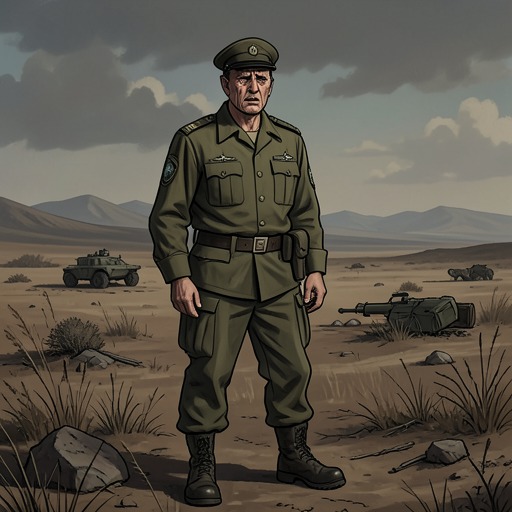
Mamiya had been assigned to accompany Yamamoto across the border with only two other men, Hamano and Corporal Honda. His selection as the escort’s commanding officer rested on his knowledge of the area: his regular work involved mapping the western border of Manchukuo near the Khalkha River, and he had surveyed the region from the air. The mission also gave him a reason to collect more detailed topographical information.
The maps available for the borderlands were crude, in part because defining the frontier risked an international crisis. The Kwantung Army was occupied with the war in China and wanted to avoid provoking the Soviet Union or Outer Mongolia by imposing a unilateral border. Yet a possible future war made accurate military maps essential: planners needed information about encampments, artillery positions, marching times, water, and horse feed. Mamiya’s mission therefore joined a sensitive military assignment to the practical work of mapping terrain that seemed to offer no reliable landmarks.
Mamiya had little experience as a battlefield officer, and Honda, newly arrived from home, was also inexperienced. The apparent weakness of the escort made Honda’s inclusion puzzling to Mamiya, though he would later understand that Honda had a particular importance. During the journey across the steppe, Mamiya experienced its vastness as disorienting: the horizon supplied almost nothing against which to check a map, and the emptiness seemed to loosen the connection between his sense of self and his physical surroundings.
The forced choice
After his capture, Mamiya was taken north to a Lamaist devotional mound, or oboo, used as a desert signpost. Nearby stood a stone-rimmed well. A guard dropped a rock into it; after a delay, it struck sand. The well was deep but dry, apparently because the underground water vein had shifted.
The guard then placed an automatic pistol against Mamiya’s head but did not fire. Pointing instead toward the well, he gave Mamiya a choice: die by the gun or jump into the hole, where a fall might kill him or leave him to die slowly. The guard indicated that Mamiya had five seconds. Mamiya stepped onto the stone curb and jumped before he could try to descend by holding the wall. His hands missed it, and he fell to the bottom.
The fall briefly deprived him of consciousness. When he came to, the soldiers were at the rim of the well; after they had left, he understood that he had been abandoned. In the darkness he could not clearly assess his body or trust his perceptions. The soft, sandy ground had spared him from worse harm, but he could barely move, and the connection between intention and physical action seemed impaired. As his perceptions gradually returned, so did intense pain; he believed his leg was broken and feared that his shoulder was dislocated or broken.
Abandonment and the light
Alone at the bottom, Mamiya faced not only injury but the uncertainty of whether anyone would know where he had died. He had no food, water, or clothing. The wind’s sound at the mouth of the well was his intermittent link to the world above, while the cold and darkness made time difficult to measure. His sense of isolation deepened into despair: a death there, he feared, would be one of which nobody was even aware.
At one point sunlight reached the bottom of the well. For perhaps ten or fifteen seconds, the light revealed the stone walls and the bones of a small animal. Its appearance briefly changed the meaning of the bones: what Mamiya could have read as a warning of his own death became, in the light, a kind of companion. The warmth also allowed him to forget fear and pain for a moment. Then the sun passed out of alignment with the well and darkness returned.
The light appeared again, seemingly brighter and longer-lasting. Mamiya received it with open hands and wept; in that interval he felt a powerful unity and believed that even death would hold no threat. But the light disappeared, leaving him where he had been, still injured and exposed to the cold. The reversal matters: the experience offers neither escape nor lasting comfort. Its force lies in how fully it seems to open another possibility, then withdraws it.
Survival and its meaning
After the light vanished, Mamiya recalled Honda’s prophecy that he would not die on the continent. The prediction had come back to him earlier, when he was bound to a saddle after his capture, and he had tried to make himself believe it. In the well, after surviving the fall and enduring an experience that seemed to bring him to the edge of death, he came to believe it differently. He concluded that he had not simply been destined to avoid dying there: he had been unable to die there.
Mamiya later tells the account to Mr. Okada and closes it by pointing to his continued survival. Of the four men who went on the mission, he says that he lived the longest. That retrospective frame makes the well more than an episode of physical peril: it is the point at which Honda’s words, Mamiya’s survival, and the fleeting sunlight become bound together in his understanding of fate. Yet Mamiya also says that whatever grace he had experienced up to that point was lost forever. Survival gives him a conviction, not a return to ordinary life or an uncomplicated consolation.
War’s logistical shadow
The ordeal is embedded in the military and political pressures that shaped Mamiya’s assignment. Years later, Mr. Okada reads that the Japanese army had recognized its unpreparedness for a possible Siberian winter campaign. A research team considered winter clothing, tested equipment on Sakhalin, and estimated that frostbite could put roughly two-thirds of front-line infantry out of action with existing gear. The account underscores how military plans depended on maps, supplies, transport, and the conditions of the land, not simply on orders or courage.
Mamiya’s later account of the Siberian mining camp extends that institutional context into captivity. The mine was managed as a strategic facility, with production targets overriding prisoners’ survival; Boris diverted supplies and used brutal calculations to raise output. These later circumstances do not alter what happened in the well, but they place Mamiya’s ordeal within a wider history of systems that treat people as expendable. Against that world, the small distinction between being shot and being abandoned in a well becomes a stark measure of how little control he had over the form his survival would take.